
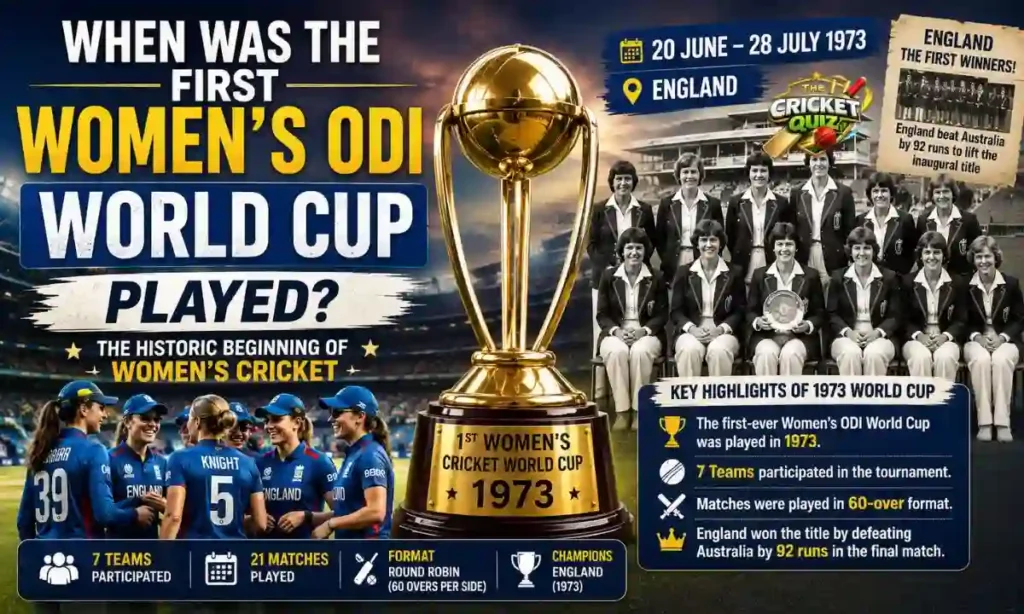
When was the first Women’s ODI World Cup organized? The very first tournament named Women’s Cricket World Cup occurred in the year 1973. Specifically, this grand event was held from June 20 till July 28, 1973. This happened to be the first ever World Cup in the sport of women’s cricket. To your surprise, this tournament occurred two years ahead of the first Men’s Cricket World Cup which was played in 1975.
It is important to mention that although the current version features 50-over games, in 1973, the tournament structure was quite different. Every team was allocated 60 overs in total. Moreover, there were no knockouts or finals round. Each team contested against other participating nations using a round-robin system and eventually, the winners were crowned based on points tally table. When was the first Women’s ODI World Cup played? Learn about the 1973 Women’s World Cup, host country, dates, participating teams, format, winner, and England’s historic victory over Australia.
When Was the First Women’s ODI World Cup Played?
The first Women’s ODI World Cup was played in 1973 in England. This tournament marked the start of the Women’s Cricket World Cup. It should be noted that during that time the international women’s cricket wasn’t controlled by the ICC, as it is nowadays. This tournament was organized by the International Women’s Cricket Council (IWCC).
| Information | Details |
|---|---|
| First Women’s World Cup | 1973 |
| Host Country | England |
| Tournament Dates | June 20 – July 28, 1973 |
| Tournament | Women’s Cricket World Cup |
| Format | 60-over One-Day Cricket |
| Total Teams | 7 |
| Total Matches | 21 |
| Tournament Format | Round Robin / League |
| First Winner | England |
| Runner-up | Australia |
| Organizing Body | International Women’s Cricket Council (IWCC) |
| Difference from Men’s World Cup | 2 Years Earlier |
It was a historical event for women’s cricket, because the tournament wasn’t so big-scale as the ICC World Cup as we know it nowadays. The organization of the tournament in those days despite all difficulties was a huge step for women’s cricket.
Why Did the First Women’s Cricket World Cup Start in 1973?
Women’s cricket has a rich history which goes back long before 1973. Women have already been playing international Test cricket for many decades before the start of the World Cup. But the idea about such kind of tournament where different nations could compete for the World Cup appeared in 1973.
It should be mentioned that former English captain Rachael Heyhoe Flint and businessman Sir Jack Hayward played an important role in organizing this tournament. In 1971 there were some negotiations between these two people about organization of such tournament, and Hayward provided financial support for this event.
Thus, the idea of the tournament became reality and it resulted in the fact that England hosted the first Women’s Cricket World Cup in 1973.
In Which Country Was the First Women’s World Cup Played?
The first Women’s World Cup was played in England on various cricket grounds in England.
England wasn’t only a host country of this tournament but also a brand new international arena for women’s cricket. The official start of the tournament was on June 20, 1973, when Jamaica and Young England played against each other.
| Question | Answer |
|---|---|
| Where was the First Women’s World Cup held? | England |
| When was it held? | 1973 |
| Tournament Start | June 20, 1973 |
| Tournament End | July 28, 1973 |
| First Champion | England |
| Decisive Match | England vs Australia |
The key match of the 1973 tournament was played in Edgbaston, Birmingham, between England and Australia. This match can be considered as the title-deciding one, as the champion was chosen according to the points table.
How Many Teams Participated in the 1973 Women’s World Cup?
There were 7 teams participated in the first Women’s World Cup. Unlike today, not all teams were national. There were also special composite teams ‘Young England’ and ‘International XI’.
| No. | Team |
|---|---|
| 1 | England |
| 2 | Australia |
| 3 | New Zealand |
| 4 | Jamaica |
| 5 | Trinidad and Tobago |
| 6 | International XI |
| 7 | Young England |
However, the fact must be noted that Young England was not a senior national team but a developmental team. Moreover, the team International XI had players representing several national teams who did not play in the World Cup.
Which Teams Played in the First Women’s World Cup?
Apart from traditional strong cricket teams such as England, Australia, and New Zealand, the 1973 tournament had regional teams representing the Caribbean – Jamaica and Trinidad & Tobago.
The full team list included:
- England Senior Women’s Team
- Young England
- Australia
- New Zealand
- Jamaica
- Trinidad and Tobago
- International XI
The reason why International XI team participated in the World Cup lies in the fact that back then the women’s cricket format included such a team.
What Was the Format of the 1973 Women’s World Cup?
The format of the first Women’s World Cup differs from today’s formats in many aspects. Namely, there were no knockout semi-finals and a stand-alone final.
All 7 teams played a round-robin league style, meaning that every team played against all six participating teams.
| Format | 1973 Arrangement |
|---|---|
| Tournament Type | Round Robin |
| Number of Teams | 7 |
| Matches per Team | 6 |
| Total Matches | 21 |
| Overs per Innings | 60 |
| Semi-Finals | None |
| Separate Final | None |
| Winner Determination | Points Table Leader |
Thus, with each team having 6 matches, there were 21 matches in total during the tournament.
Was There a Final Match in the 1973 Women’s World Cup?
The confusion may arise from the fact that a World Cup usually implies the existence of knockout semi-finals and a final match after the league phase.
In the 1973 Women’s World Cup, there was no scheduled final match. Namely, the tournament was conducted in a form of round-robin league, with the winning team being the one with the most points.
However, the last scheduled match of the tournament was England vs Australia, and the fact is that these teams were the ones fighting for the title. Thus, this match became, in practice, the final of the tournament, with England becoming the winners and getting the trophy.
How Many Overs Were Played per Match in the 1973 Women’s World Cup?
While the number of overs in modern Women’s ODI innings is 50, this was not the case in 1973.
Namely, every innings of the first Women’s World Cup consisted of 60 overs.
| Era | Number of Overs |
|---|---|
| 1973 Women’s World Cup | 60 Overs |
| Modern Women’s ODI | 50 Overs |
The understanding of the format of the first World Cup should include the fact that at that time the One Day format of the game was quite different from the modern 50-over ODI format.
Who Won the First Women’s World Cup?
The first Women’s Cricket World Cup was won by England.
Namely, England was performing extremely well during the tournament and ended up being the leader of the points table, while Australia took the runner-up position.
| Position | Team | Result |
|---|---|---|
| 1 | England | Champion |
| 2 | Australia | Runner-up |
| 3 | New Zealand | Tournament Participant |
| 4 | International XI | Tournament Participant |
| 5 | Trinidad and Tobago | Tournament Participant |
| 6 | Jamaica | Tournament Participant |
| 7 | Young England | Tournament Participant |
Thus, England became the first champion of the Women’s Cricket World Cup.
How Did England Win the First Women’s World Cup?
Namely, the final scheduled match of the tournament between England and Australia took place on July 28, 1973, at Edgbaston. Prior to this match, Australia led England on points and it was necessary for England to win in order to become the champions.
England batter Enid Bakewell showed a magnificent performance with 118 runs and helped the team make 279/3 in 60 overs. Australia replied with 187/9 in 60 overs.
Thus, England defeated Australia by 92 runs, taking them the leadership in the points table and winning the first Women’s World Cup.
What Was Enid Bakewell’s Contribution to the 1973 Women’s World Cup?
Namely, England’s Enid Bakewell was one of the best individual performers of the tournament.
She showed 264 runs during the tournament, becoming the leading scorer with an average of 88.00. Also, she scored two centuries in the tournament, including 118-run inning in the match against Australia.
| Enid Bakewell Record | Details |
|---|---|
| Team | England |
| Tournament | 1973 Women’s World Cup |
| Total Runs | 264 |
| Centuries | 2 |
| Batting Average | 88.00 |
| Tournament Position | Leading Run-scorer |
| Decisive Match Score | 118 Runs |
Namely, her contribution became one of the most memorable performances in the history of early Women’s World Cups.
Who Took the Most Wickets in the 1973 Women’s World Cup?
Namely, in the bowling department, Rosalind Heggs showed the best performance during the 1973 Women’s World Cup, taking 12 wickets in total.
Being part of the Young England side, her swing bowling was quite influential throughout the tournament.
| Record | Player | Performance |
|---|---|---|
| Most Runs | Enid Bakewell | 264 Runs |
| Most Wickets | Rosalind Heggs | 12 Wickets |
This fact proves that the first Women’s World Cup was not only about rivalry between England and Australia, but also about individual achievements of players.
Why Is the First Women’s World Cup Remembered for Being Before the Men’s World Cup?
The fact that the first Women’s Cricket World Cup took place two years earlier than the first Men’s Cricket World Cup is quite interesting historically.
Namely, the first Women’s World Cup was played in 1973, while the first Men’s Cricket World Cup was played in 1975.
| Tournament | First Edition |
|---|---|
| Women’s Cricket World Cup | 1973 |
| Men’s Cricket World Cup | 1975 |
| Difference | 2 Years Earlier |
Sir Jack Hayward’s Role in Organizing the First Women’s World Cup
Namely, financial and organizational support of Sir Jack Hayward became a crucial factor in holding the first Women’s World Cup. This man is a British businessman who supported the initiative of organizing this tournament in order to improve the status of women’s cricket internationally.
Thus, he donated £40,000 which helped in covering all the expenses connected with organizing the tournament, accommodation and travel of players. During the time when female players did not have any match fees and corporate sponsorships, this money was a basis for the tournament.
Rachael Heyhoe Flint’s Contribution and Honor
Namely, Rachael Heyhoe Flint was the captain of English women’s cricket team. She was the key person in convincing Sir Jack Hayward of the need to organize such World Cup in 1971.
For the recognition of her exceptional contribution to the game, ICC later named its Women’s Cricketer of the Year Award “the Rachael Heyhoe Flint Trophy”.
Key Facts of the 1973 Women’s World Cup
| Fact | Information |
|---|---|
| First Women’s World Cup | 1973 |
| Host Country | England |
| Start Date | June 20, 1973 |
| End Date | July 28, 1973 |
| Teams / Matches | 7 Teams / 21 Matches |
| Overs | 60 per innings |
| Format | Round Robin |
| Winner / Runner-up | England / Australia |
| Leading Run Scorer | Enid Bakewell (264 Runs) |
| Leading Wicket Taker | Rosalind Heggs (12 Wickets) |
| Decisive Match | England vs Australia |
| Decisive Match Venue | Edgbaston |
| England’s Winning Margin | 92 Runs |
| Ahead of Men’s WC | 2 Years Earlier |
Why Was the 1973 Women’s World Cup Historic?
Namely, the 1973 World Cup became not only the cricket tournament but also the way of giving women’s cricket a global platform on which players from different countries can compete for the international title.
Back then, women’s cricket had no media coverage, sponsorships and professional contracts. However, it managed to hold a successful multi-week seven-team tournament.
England vs Australia Decisive Match in the 1973 Women’s World Cup
Since there was no stand-alone final match in 1973, the round-robin match between England and Australia on July 28 at Edgbaston, Birmingham became the ultimate title decider of the tournament. Namely, before the match, Australia had a point lead and thus England had to win in order to take the title.
England chose to bat first and scored a powerful 279/3 in 60 overs with the help of Enid Bakewell’s 118 and captain Rachael Heyhoe Flint’s half-century. Australia managed to reply with 187/9 in 60 overs, giving 92-run victory to England.
| Match Information | Details |
|---|---|
| Date | July 28, 1973 |
| Venue | Edgbaston, Birmingham |
| Teams | England vs Australia |
| England Score | 279/3 (60 Overs) |
| Australia Score | 187/9 (60 Overs) |
| Result | England won by 92 runs |
| Key Batter | Enid Bakewell (118 runs) |
| Tournament Winner | England |
What Was the Points Table of the 1973 Women’s World Cup?
Namely, all 7 teams played one match against each other. England won 5 and lost 1 match (against New Zealand). Australia won 4, lost 1 and got 1 no result.
| Team | Tournament Performance | Total Points |
|---|---|---|
| England | 5 Wins, 1 Loss | 20 |
| Australia | 4 Wins, 1 Loss, 1 No Result | 17 |
| New Zealand | 3 Wins, 2 Losses, 1 No Result | 13 |
| International XI | 3 Wins, 2 Losses, 1 No Result | 13 |
| Trinidad and Tobago | 2 Wins, 4 Losses | 8 |
| Jamaica | 1 Win, 4 Losses, 1 No Result | 5 |
| Young England | 1 Win, 5 Losses | 4 |
England became 3 points ahead of Australia in the last match and became the winners of the tournament.
Enid Bakewell’s Performance in the 1973 Women’s World Cup
Namely, Enid Bakewell became the leading star of the inaugural edition showing 264 runs in 6 matches with an average of 88.00. Moreover, she showed two centuries in the tournament, including 118-run against Australia.
| Enid Bakewell Record | Details |
|---|---|
| Team | England |
| Matches | 6 |
| Total Runs | 264 |
| Batting Average | 88.00 |
| Centuries | 2 |
| Highest Score | 118 |
| Tournament Status | Leading Run-Scorer |
Who Took the Most Wickets in the 1973 Women’s World Cup?
While Enid Bakewell was the leader among the run scorers, Rosalind Heggs of Young England was leading the bowling charts with 12 wickets in the tournament.
| Bowling Record | Details |
|---|---|
| Player | Rosalind Heggs |
| Team | Young England |
| Wickets | 12 |
| Tournament Status | Leading Wicket-Taker |
What Was India’s Connection with the First Women’s World Cup?
India was not a part of the 1973 Women’s World Cup since there were no governing bodies for women’s cricket in India at that time.
The Women’s Cricket Association of India (WCAI) was founded in 1973, which was too soon for them to participate in that tournament. India debuted internationally in 1976 and participated in their first-ever Women’s World Cup in 1978, which was hosted by India itself.
| Indian Women’s Cricket Journey | Year |
|---|---|
| WCAI Establishment | 1973 |
| First International Match | 1976 |
| First World Cup Debut | 1978 |
| First World Cup Hosting | 1978 |
When Did India Play the Women’s World Cup for the First Time?
India participated in their first ever Women’s Cricket World Cup in 1978 when it was held in India. This tournament consisted of four nations including India, Australia, England, and New Zealand.
Although India could not win a single match in that edition, it marked the participation of Indian women’s cricket in the global tournament history.
What Changed in the 1978 Women’s World Cup?
The 1978 Women’s World Cup was held with 4 teams only (India, Australia, England, and New Zealand) as opposed to 7 teams in the previous editions. Australia stayed unbeaten in that round-robin format and became the champions of the World Cup.
| 1978 World Cup Detail | Information |
|---|---|
| Host | India |
| Number of Teams | 4 |
| Teams | India, Australia, England, New Zealand |
| Winner | Australia |
| Runner-up | England |
| Format | Round Robin |
| India Result | No Wins |
Major Change in the 1982 Women’s World Cup
This edition of the World Cup hosted by New Zealand saw a significant change in its structure. There was an official final match for the first time where Australia defeated England by 3 wickets to become the champions.
How Did the Women’s World Cup Format Change Over Time?
Since 1973, the Women’s World Cup has seen many structural changes to its format.
| Year | Key Format Changes |
|---|---|
| 1973 | Round Robin, No Final (60 Overs) |
| 1978 | 4-Team Round Robin |
| 1982 | First Official Final Introduced |
| 1988 | Double-League Format |
| Later Editions | League + Knockout Structure |
| Modern Era | 50-Over One-Day International Format |
What Is ICC’s Role and When Did It Begin?
Earlier editions of Women’s World Cup used to be organized by the International Women’s Cricket Council (IWCC). In 2005, the IWCC was merged with the International Cricket Council (ICC). 2009 was the first year when the Women’s World Cup was organized by the ICC.
Journey of the Women’s World Cup from Inception to Today
Having started with just 7 teams in 1973, the Women’s World Cup has grown into a grand tournament. The Women’s World Cup has been won 7 times by Australia, 4 times by England, once by New Zealand, and India has made to the finals twice (2005, 2017).
List of Women’s World Cup Winners
| Year | Host | Winner |
|---|---|---|
| 1973 | England | England |
| 1978 | India | Australia |
| 1982 | New Zealand | Australia |
| 1988 | Australia | Australia |
| 1993 | England | England |
| 1997 | India | Australia |
| 2000 | New Zealand | New Zealand |
| 2005 | South Africa | Australia |
| 2009 | Australia | England |
| 2013 | India | Australia |
| 2017 | England | England |
| 2022 | New Zealand | Australia |
First Women’s ODI World Cup: Key Points to Remember
Key facts to know quickly and revise for exams:
| Question | Correct Answer |
|---|---|
| When was the First Women’s World Cup? | 1973 |
| Where was it held? | England |
| Who was the first champion? | England |
| Who was the runner-up? | Australia |
| How many teams participated? | 7 |
| What was the format? | Round Robin |
| Was there a separate final? | No |
| How many overs per innings? | 60 Overs |
| Who scored the most runs? | Enid Bakewell (264 Runs) |
| Who took the most wickets? | Rosalind Heggs (12 Wickets) |
| Decisive Match? | England vs Australia |
| England’s winning margin? | 92 Runs |
| When did India debut? | 1978 |
| First official final year? | 1982 |
First Women’s ODI World Cup Quiz
1. In which year was the first Women’s Cricket World Cup played?
A. 1971
B. 1973
C. 1975
D. 1978
Answer: B. 1973
2. Which country hosted the first Women’s World Cup?
A. Australia
B. India
C. England
D. New Zealand
Answer: C. England
3. Which team won the first Women’s World Cup?
A. Australia
B. England
C. New Zealand
D. India
Answer: B. England
4. How many teams participated in the 1973 Women’s World Cup?
A. 4
B. 5
C. 7
D. 8
Answer: C. 7
5. How many overs per innings were played in 1973?
A. 40
B. 50
C. 60
D. 65
Answer: C. 60
6. Who was the leading run-scorer in the 1973 tournament?
A. Rachael Heyhoe-Flint
B. Enid Bakewell
C. Lynne Thomas
D. Margaret Jennings
Answer: B. Enid Bakewell
7. How many runs did Enid Bakewell score in the 1973 World Cup?
A. 218
B. 246
C. 264
D. 279
Answer: C. 264
8. Which two teams played the decisive match in 1973?
A. England vs New Zealand
B. Australia vs New Zealand
C. England vs Australia
D. India vs Australia
Answer: C. England vs Australia
9. By how many runs did England defeat Australia?
A. 47 runs
B. 66 runs
C. 92 runs
D. 118 runs
Answer: C. 92 runs
10. In which year did India play in the Women’s World Cup for the first time?
A. 1973
B. 1976
C. 1978
D. 1982
Answer: C. 1978
FAQs
When was the first Women’s ODI World Cup played?
The first Women’s Cricket World Cup was played in England in 1973, two years before the first Men’s World Cup.
Who won the first Women’s World Cup?
England won the first Women’s Cricket World Cup in 1973, defeating Australia by 92 runs in the decisive final league match.
Where was the first Women’s World Cup held?
The first Women’s World Cup was hosted by England.
How many teams participated in the 1973 Women’s World Cup?
There were 7 teams: England, Australia, New Zealand, Jamaica, Trinidad & Tobago, International XI, and Young England.
Was there a final match in the 1973 Women’s World Cup?
No official standalone final was scheduled. The tournament was played in a round-robin league format, though the final league match between England and Australia acted as the title decider.
Conclusion
The first Women’s ODI World Cup took place in 1973 in England, in which the host country became the first champion. With seven teams, 60-over inning, and round-robin format, the tournament laid the foundation for modern women’s international cricket.
England beat Australia by 92 runs in the final at Edgbaston on 28th July 1973 and became the first champions of the World Cup.
Also, Read About: How Many Times RCB Qualified For Playoffs In IPL? Complete History & Records