
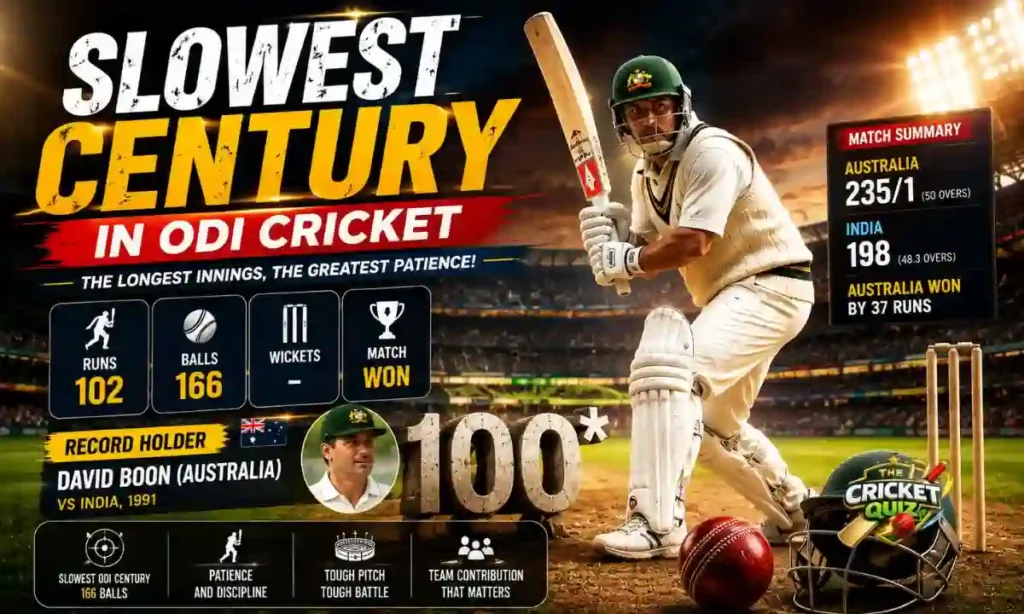
Cricket matches organized under ODI format are recognized due to the perfect combination of patience and aggressiveness. There are some players, who scored fast centuries while others set records playing very patiently and concentrating much. The Slowest Century in ODI Cricket is a special record which demonstrates the skills of handling pressure and challenging conditions and dealing with a quality attack.
While in case of fast centuries batters beat bowlers with their aggressiveness and quick scoring, slow centuries happen during difficult situations where every run is thought through and planned. Such innings cannot boast a good strike rate but can be crucial for the creation of a competitive score or getting out of difficult position. Let’s see who holds the record of the Slowest Century in ODI Cricket and learn some interesting facts.

Quick Overview
| Details | Information |
| Format | One Day International (ODI) |
| Record Type | Slowest Century |
| Calculation Based On | Balls Faced |
| Slowest ODI Century | David Boon |
| Balls Taken | 166 Balls |
| Runs Scored | 102 Runs |
| Country | Australia |
| Opponent | India |
| Year | 1991 |
What Is the Slowest Century in ODI Cricket?
Slowest century in ODI cricket means that the longest time was taken by a batsman to score 100 runs in terms of balls faced. For the creation of the record is taken into account how many deliveries a batter took to reach 100-run mark.
In the modern ODI cricket, when fast centuries have become quite common for the top players, slow centuries are special cases as they reflect patience, technical ability and survival of the player. The slowest century in ODI cricket does not necessarily mean the bad batting but sometimes it shows the conditions, quality of the bowling attack and the responsibility given to the player.
How Is the Slowest ODI Century Record Calculated?
The record of the slowest century is mainly defined by the number of deliveries a batter needs to reach the century mark. The more deliveries a batsman takes to score the century, the higher he/she places in the list of slowest ODI centuries. But the value of the innings is not only the speed but also its importance for the situation of the team.
| Factor | Importance |
| Balls Faced | Main criteria for slowest century record |
| Runs Scored | Batter must complete 100 or more runs |
| Strike Rate | Shows scoring speed during innings |
| Match Situation | Explains the importance of innings |
| Pitch Condition | Affects batting difficulty |
Top 10 Slowest Centuries in ODI Cricket History
There were several legends of cricket, who managed to score slow centuries in ODI matches. They played in different periods when the strategy and tactics of ODI cricket were different.
| Rank | Player | Country | Balls Faced | Runs | Opponent | Year |
| 1 | David Boon | Australia | 166 Balls | 102 | India | 1991 |
| 2 | Rameez Raja | Pakistan | 157 Balls | 102 | West Indies | 1992 |
| 3 | Geoff Marsh | Australia | 156 Balls | 111 | England | 1989 |
| 4 | Rameez Raja | Pakistan | 152 Balls | 107 | Sri Lanka | 1990 |
| 5 | Scott Styris | New Zealand | 152 Balls | 111 | Sri Lanka | 2007 |
| 6 | Tom Cooper | Netherlands | 151 Balls | 101 | Afghanistan | 2010 |
| 7 | Gordon Greenidge | West Indies | 146 Balls | 103 | Pakistan | 1988 |
| 8 | David Hemp | Bermuda | 144 Balls | 102 | Canada | 2007 |
| 9 | Sunil Gavaskar | India | 144 Balls | 103 | New Zealand | 1987 |
| 10 | Sourav Ganguly | India | 141 Balls | 105 | South Africa | 2000 |
1. David Boon – Slowest Century in ODI Cricket History
David Boon holds the record for the Slowest Century in ODI Cricket after scoring 102 runs from 166 balls against India in 1991. This innings is one of the most patient hundreds in ODI history.
During the period when ODI cricket was more based on building the innings rather than power hitting, Boon demonstrated excellent concentration and technical skills. He faced a quality Indian bowling attack and played depending on the situation of the game rather than trying to chase the high strike rate.
His century proved that successful ODI batting is not always fast. Sometimes, it is necessary to occupy the crease and build partnerships.
David Boon Player Overview
| Details | Information |
| Full Name | David Clarence Boon |
| Country | Australia |
| Role | Top Order Batter |
| Batting Style | Right-Handed Batter |
| ODI Debut | 1984 |
| Playing Era | 1980s–1990s |
| Famous For | Solid Technique and Reliable Batting |
David Boon Slowest ODI Century Match Details
| Details | Information |
| Batter | David Boon |
| Team | Australia |
| Opponent | India |
| Runs Scored | 102* Runs |
| Balls Faced | 166 Balls |
| Year | 1991 |
| Format | ODI |
| Record | Slowest ODI Century |
David Boon’s Batting Analysis
David Boon’s innings was centered around patience, defensive skills and great shot selections. Unlike some other players, he did not make rash moves but tried to rotate strikes and spend more time on crease.
During that match, it was very difficult to score fast runs due to Indian bowling lineup that applied pressure on Australia. The task of Boon was to stabilize the innings, which was possible thanks to his ability to control the situation and made this century very special for its slowness.
Pitch Conditions During David Boon’s Century
The pitch of that day contributed greatly to the slowness of Boon’s inning. The surface was hard for batsmen to time their shots and score easy boundaries.
| Pitch Factor | Impact on Batting |
| Slow Surface | Difficult to score quickly and hit through the line |
| Limited Bounce | Timing became challenging for stroke-makers |
| Quality Bowling | Indian bowlers kept tight lines, increasing pressure |
| Large Ground Area | Hard to clear boundaries, relied heavily on running |
David Boon Match Result and Impact of His Slow Century
David Boon’s 102 run inning became one of the most valuable slowest centuries in the history of ODI cricket due to the influence of patience and experience on the result of the match. Thanks to him Australia managed to build a stable total and this slow inning showed that a century does not have to be quick to bring good results.
Although it was quite slow for modern ODI cricket, it was very effective because Boon managed to control the situation and give stability to the batting lineup. This performance will not be forgotten when talking about the Slowest Century in ODI Cricket.
| Match Factor | Details |
| Player | David Boon |
| Team | Australia |
| Opponent | India |
| Contribution | 102 Runs |
| Main Role | Anchoring and building the innings |
| Impact | Provided stability and helped Australia win the match |
2. Rameez Raja – 157 Ball Century
Rameez Raja is one of the players who managed to get one of the slowest centuries in the history of ODI cricket. The player scored his century in 157 balls playing against West Indies during 1992 World Cup that took place during the era of slow batting style.
Unlike modern fast batting techniques, Rameez used such things as timing, placement and careful strokes. The inning reflected the importance of spending time on crease and helping the team to build a stable total.
Rameez Raja Player Overview
| Details | Information |
| Full Name | Rameez Hasan Raja |
| Country | Pakistan |
| Role | Opening Batter |
| Batting Style | Right-Handed Batter |
| Playing Era | 1980s–1990s |
| Known For | Elegant Stroke Play |
Rameez Raja Century Details
| Details | Information |
| Runs Scored | 102* Runs |
| Balls Faced | 157 Balls |
| Format | ODI |
| Batting Position | Opening Batter |
| Style | Highly defensive and patient innings |
Rameez Raja Batting Analysis
Rameez Raja’s century was built on patience and careful shot selection. Opening batter was playing against a brutal West Indian bowling lineup and his task was to make a solid base for Pakistan, which he managed to do by spending a lot of time on crease.
This inning was a reflection of batting style of those times, when it was much more important to protect wickets and build partnerships than to have very high strike rate.
3. Geoff Marsh – 156 Ball Century
Geoff Marsh, who is considered one of the most successful openers of Australia, is also included in the list of cricketers who score centuries in ODI at the slowest pace.
The 156 ball century of Marsh shows that he had very good defensive skills and was also able to judge the condition of the match.
Geoff Marsh Player Overview
| Details | Information |
| Full Name | Geoffrey Robert Marsh |
| Country | Australia |
| Role | Opening Batter |
| Batting Style | Right-Handed Batter |
| Strength | Exceptional Patience and Technique |
Geoff Marsh Century Details
| Details | Information |
| Runs | 111* Runs |
| Balls Faced | 156 Balls |
| Format | ODI |
| Playing Style | Defensive, reliable, and solid anchoring |
4. Scott Styris – 143 Ball Century
One of the slowest ODI centuries is that of Scott Styris of New Zealand. Unlike the traditional defensive batters, Styris could play attacking cricket but would adapt according to the conditions prevailing during that difficult match.
Thus, this century of Scott Styris shows that sometimes even the players of modern era had to play slowly.
Scott Styris Century Details
| Details | Information |
| Country | New Zealand |
| Role | All-Rounder |
| Runs | 111* Runs |
| Balls Faced | 152 Balls |
| Strength | Excellent adaptability and situational awareness |
5. Tom Cooper – 138 Ball Century
Tom Cooper’s century for the team of Netherlands is one of the important centuries in the list of slow ODI hundreds. While playing for an associate nation, he played a very responsible innings and played well against the disciplined bowling attack.
This innings of Tom Cooper proved that ODI cricket is not a sport for the giants alone; the players of developing cricket nations have also achieved something great.
Tom Cooper Century Details
| Details | Information |
| Country | Netherlands |
| Role | Top-order Batter |
| Runs | 101 Runs |
| Balls Faced | 151 Balls |
| Contribution | Match-building innings under pressure |
Slowest ODI Century by Indian Players
Batters of India have also scored slow centuries during the course of their ODI career due to varying conditions and situations in the matches.
| Player | Balls Faced | Runs | Opponent | Year |
| Sunil Gavaskar | 144 Balls | 103 | New Zealand | 1987 |
| Sourav Ganguly | 141 Balls | 105 | South Africa | 2000 |
| Rahul Dravid | 137 Balls | 104 | United Arab Emirates | 2004 |
| Sachin Tendulkar | 138 Balls | 114 | Bangladesh | 2012 |
Slowest Century vs Fastest Century in ODI Cricket
Comparison between the slowest and fastest centuries in ODI cricket gives us an idea about the evolution of cricket over the years. While former generations preferred building innings, modern day cricket prefers aggression and stroke play.
| Category | Player | Balls Taken | Country | Opponent & Year |
| Slowest ODI Century | David Boon | 166 Balls | Australia | vs India (1991) |
| Fastest ODI Century | AB de Villiers | 31 Balls | South Africa | vs West Indies (2015) |
Batting Analysis of Slow ODI Centuries
Scoring a slow century requires a totally different approach in comparison with scoring a quick century. In order to score such centuries, a batter requires great concentration, patience and the ability to withstand pressure for a long duration.
| Skill | Importance |
| Defensive Technique | Helps survive difficult or swinging bowling spells |
| Shot Selection | Avoids unnecessary risks and aerial shots |
| Patience | Allows long innings building without frustration from dot balls |
| Strike Rotation | Keeps the scoreboard moving even when boundaries dry up |
| Mental Strength | Handles extreme pressure situations and match scenarios |
Pitch Characteristics Behind Slow ODI Centuries
Pitch conditions play a crucial role in scoring slow centuries. If the pitch is difficult, the scoring rate can be slowed down significantly and the batter might be required to change his natural attacking style.
| Pitch Type | Effect on Batting |
| Slow Pitch | Ball comes slowly onto the bat, making timing incredibly tough |
| Low Bounce Pitch | Reduces the possibility of playing horizontal-bat shots like cuts or pulls |
| Turning Track | Spinners get heavy assistance, making strike rotation very hard |
| Green Pitch | Fast bowlers get seam and swing movement, forcing defensive play |
| Dry Surface | Uneven pace means batters need more patience to get set |
Why Do Players Score Slow Centuries in ODI Cricket?
Several factors can influence the time taken by the batter to score his century in ODI cricket. The slow century is not always an indicator of bad batting; there are cases where these centuries turned out to be match-winning or match-saving.
- Difficult pitch conditions or heavy weather assistance for bowlers.
- Facing an exceptionally strong and highly disciplined bowling attack.
- Early loss of quick wickets, putting the middle order under immense pressure.
- Responsibility to anchor the innings and bat through the full 50 overs.
- High pressure of a major tournament or a crucial knockout match.
- Absolute need to protect the team’s total from a collapse.
Are Slow Centuries Valuable in ODI Cricket?
Not every slow century in ODI cricket can be said to be a poor inning for a batsman. This game takes into account a lot of aspects such as situation of the match, pitch, and bowling skills of the opponents. At times, the batsman needs to play cautiously since losing his wickets early can affect the whole team in a bad way.
There are several instances in which a slow hundred has contributed greatly to setting up a competitive total or winning the match in favor of the team. It showcases the skills of the seasoned batsmen who are aware of what situation requires an attack and what situation needs caution.
Batsmen who score 100 runs in 150 balls don’t seem to have done a great job with regards to the strike rate but sometimes, a difficult pitch and falling wickets of other players make their century worth remembering as one of the most valuable innings of the match.
Factors That Make a Slow Century Important
| Factor | Importance |
| Match Situation | Helps the team recover from a top-order collapse |
| Pitch Difficulty | Shows supreme technical batting skills on tough, unplayable surfaces |
| Bowling Quality | Performing against a world-class bowling attack increases the knock’s value |
| Partnership Building | Provides much-needed stability to the lower order and long partnerships |
| Team Requirement | Sometimes survival and playing the full overs is more important than speed |
Slowest Century in ODI Cricket: Impact on Team Performance
The importance of a slow century lies in its influence on the final score. The slowest centuries that make it into record books are the ones that helped teams to win crucial games or were just great performances despite the end result.
| Player | Century Speed | Team Impact |
| David Boon | 166 Balls | Provided absolute stability and helped Australia secure a win |
| Rameez Raja | 157 Balls | Built a solid foundation against a lethal West Indies pace battery |
| Geoff Marsh | 156 Balls | Controlled the entire innings to set up a winning total against England |
| Scott Styris | 152 Balls | Crucial knock anchoring New Zealand’s run-chase under heavy pressure |
Evolution of ODI Batting: From Slow Centuries to Fast Hundreds
ODI cricket has seen many changes throughout the years. In the early days of the format, batters used to focus more on protecting their wickets and playing a long innings. The strike rate was less important than it is nowadays.
The era of modern ODI cricket has brought many new things such as aggressive approaches, power hitting, good physical condition, small boundaries, and special shots. This resulted in the fact that nowadays centuries are being scored faster than in previous decades.
Nevertheless, slow centuries will always be valuable for the history of cricket sport since they symbolize patience, skills, and great understanding of the game.
Slowest Century in ODI Cricket vs Modern Batting Style
| Era | Batting Approach |
| 1970s–1990s | Pure defensive batting, long partnerships, and safety-first approach |
| 2000s | A balanced approach between steady accumulation and occasional attack |
| 2010s–Present | Ultra-aggressive batting, high strike rates, and constant boundary-hunting |
Interesting Facts About Slowest Century in ODI Cricket
- David Boon’s 166-ball century is officially the slowest ODI century in terms of balls faced.
- Slow centuries were highly common during the early 1980s and 90s due to the nature of the format.
- Modern cricket has seen a massive increase in overall team strike rates and scoring speeds.
- A slow century can still easily turn out to be a match-winning innings depending on the pitch.
- Pitch conditions often solely decide whether a batter can score quickly or has to grind it out.
- Experienced players usually handle high-pressure situations much better than youngsters.
- Opening batters often score slower centuries because they have to face the brand-new ball and swinging conditions.
- Difficult bowling attacks can easily force even aggressive batters into completely defensive strategies.
- Strike rate alone does not decide the actual value or impact of an innings.
- Many legendary players have played incredibly patient ODI innings during their illustrious careers.
Cricket Quiz: Slowest Century in ODI Cricket
1. Who scored the slowest century in ODI cricket history?
- A) Sachin Tendulkar
- B) David Boon ✓
- C) Virat Kohli
- D) Ricky Ponting
2. How many balls did David Boon take to complete his ODI century?
- A) 140 Balls
- B) 150 Balls
- C) 166 Balls ✓
- D) 180 Balls
3. David Boon represented which country?
- A) England
- B) Australia ✓
- C) New Zealand
- D) South Africa
4. Slowest ODI century record is calculated on the basis of:
- A) Runs scored
- B) Balls faced ✓
- C) Match result
- D) Number of boundaries
5. Which player is famous for the fastest ODI century?
- A) AB de Villiers ✓
- B) MS Dhoni
- C) Rohit Sharma
- D) Brian Lara
6. Which factor can make a century slower?
- A) Easy batting pitch
- B) Strong bowling attack ✓
- C) Small ground
- D) Weak fielding
7. Slow centuries mainly show:
- A) Poor batting always
- B) Patience and match awareness ✓
- C) Lack of skill
- D) Defensive weakness
8. Which format is being discussed in this record?
- A) Test Cricket
- B) T20 Cricket
- C) ODI Cricket ✓
- D) The Hundred
9. A batter needs how many runs to complete a century?
- A) 50
- B) 75
- C) 100 ✓
- D) 150
10. Are slow centuries always bad innings?
- A) Yes
- B) No ✓
- C) Only in ODI
- D) Only in World Cup
Conclusion
The Slowest Century in ODI Cricket is an extraordinary record which proves that sometimes patience, techniques, and match awareness are very important. Although modern cricket tends to be faster and more aggressive, slow centuries help fans realize that each specific situation has its own approach.
The case of David Boon who managed to make a century in 166 balls is one of the most unforgettable slow centuries in ODI cricket. They prove that it is not only possible but also necessary to use different tactics in cricket.
FAQs
1. Who scored the slowest century in ODI cricket?
David Boon holds the official record for the slowest century in ODI cricket history, scoring 102* runs from 166 balls against India.
2. How many balls did David Boon take for his slowest ODI century?
David Boon completed his century in 166 balls, making it the slowest ODI hundred based on deliveries faced.
3. Is a slow century considered a bad innings?
No, not at all. Its total value completely depends on the match conditions, pitch difficulty, and specific team requirements at that time.
4. Why do players score slow centuries?
Players score slow centuries because of difficult pitch conditions, highly disciplined bowling attacks, high-pressure situations, or an early top-order collapse.
5. Who scored the fastest century in ODI cricket?
AB de Villiers holds the record for the fastest ODI century, reaching the 100-run mark in just 31 balls against the West Indies in 2015.
6. How is the slowest ODI century record decided?
The record is strictly decided by the total number of balls a batter takes to complete exactly 100 runs in an ODI match.
7. Can a slow century help a team win?
Yes, absolutely. Many slow centuries have directly helped teams build competitive totals, recover from collapses, or safely anchor a tough run-chase.
8. Do modern players score slow centuries?
Yes, even though modern cricket heavily focuses on aggressive batting, players still have to score slow centuries depending on extreme match conditions and tough pitches.
Also, Read About: 2nd God Of Cricket In World – Virat Kohli Records, Career, Achievements & Facts